Evolutio Journal
TFL pain: why your outer hip hurts, and what actually fixes it
Outer hip pain is one of the most commonly misdiagnosed things we see in Richmond. The tensor fasciae latae is usually involved, but it is usually not the real problem.
Pain at the front and outside of your hip is usually the tensor fasciae latae. It hurts because it is overworked, and that normally happens when your glutes are not taking their share of the load.
Stretching and foam rolling ease it for a few days. Loaded glute strengthening is what stops it returning. Most straightforward cases settle in two to six weeks.
If you have had it for months, or your pain sits deep in the groin rather than the outer hip, it is probably something else. We have covered that in when it is not the TFL.
We see this one most weeks. You have pain on the outside of your hip. Someone has told you it is bursitis, or your IT band, or that you just need to stretch more. You have foam rolled it faithfully for six weeks and it is no better. Perhaps you have had a scan that showed nothing much, which was reassuring and completely unhelpful at the same time.
More often than not, the tensor fasciae latae is the tissue that hurts. It is rarely the reason it hurts, and that distinction is the whole point of this article. If we treat the sore muscle, it settles for a fortnight. If we work out why it was overloaded in the first place, it stops coming back.
What the TFL is and what it does
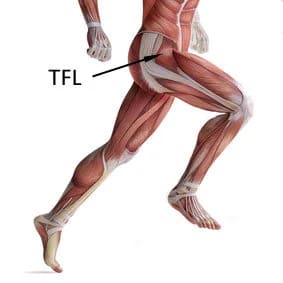
The tensor fasciae latae is a small muscle at the front and outside of your hip. It runs from the bony point you can feel at the front of your pelvis, known as the anterior superior iliac spine, down into the iliotibial band. That is the thick sheet of connective tissue running along the outside of your thigh to your knee.
It has three jobs: it helps take your leg out to the side, it assists with turning the thigh inward, and it contributes to hip flexion. Its most important job, though, is stabilising your pelvis when you are standing on one leg. During walking or running, that is most of the time.
That last point is the one that matters to you. The TFL is a small muscle carrying a big stabilising responsibility, and it shares that job with the much larger gluteus medius and gluteus maximus. When your glutes are not pulling their weight, your TFL picks up load it was never built to carry.
The TFL is usually the tissue that hurts. The glutes are usually the reason.
What TFL pain actually feels like
Typically:
A deep ache at the front and outside of the hip, roughly a hand's width below the bony point at the front of your pelvis. Pain that gets worse with anything on one leg, like stairs, hills, running, or standing on one foot to put your trousers on. Discomfort lying on that side at night. Sometimes a pulling sensation down the outside of the thigh toward the knee, following the line of the IT band.
What it usually is not is deep groin pain. That points more toward the hip joint itself and needs a different assessment, which we cover on our hip pain page.
Why it flares in Melbourne, specifically
This is not a universal muscle problem. What overloads the TFL depends a lot on how you train and how you get to work, and at our Richmond clinic we see the same handful of triggers again and again.
The desk-then-gym pattern. Eight or nine hours seated in the CBD leaves the hip flexors shortened and the glutes largely dormant. Then a 6pm class asks for repeated squatting, lunging and single-leg work from a hip that has not moved properly all day. The TFL is the muscle that picks up the slack.
Camber on the running routes. The Tan, the Yarra trail and the Capital City Trail all have cross-slope. Run the same direction on a cambered path often enough and one hip is repeatedly loaded in relative adduction, which is precisely the position that irritates the TFL and IT band. If your pain is one-sided and you always run the same loop the same way, that is worth examining.
Cycling volume and bike position. A saddle that is too high, or cleats rotated poorly, increases the work through your outer hip on every pedal stroke, and there are several thousand of those in a ride. Our partners at Ciclo in the same building do bike fitting for exactly this reason, and it is often the fix when cycling-related hip pain keeps returning after treatment.
High-volume squatting and lunging. A large share of the CrossFit population we treat, including athletes from CrossFit Hawthorn East and CrossFit CBD, present with outer hip pain that traces back to knees drifting inward under fatigue rather than anything wrong with the hip itself.
Hills. If you live around Richmond, Kew or Hawthorn, your daily walking involves more gradient than you probably register. Uphill walking demands more from hip stabilisers, and it is a common reason people notice symptoms without having changed their training at all.
Three tests you can do at home
None of these tells you the answer on its own, but together they give you a decent idea of whether hip stability is the real issue.
Single-leg stand. Stand on the painful side for 30 seconds, ideally in front of a mirror. Watch the opposite hip. If it drops, or your torso leans over the standing leg to compensate, the gluteus medius on the standing side is not doing its share.
Side-lying leg lift. Lie on your side, top leg straight, and lift it toward the ceiling. Hold ten seconds. If the leg drifts forward, the hip rolls back, or you feel it working hard at the front and outside of the hip rather than in the buttock, the TFL is substituting for the glutes.
Watch yourself squat. Film it from the front on your phone. Look at whether the knees track over the feet or fall inward as you descend, and whether one side dips more than the other. Knee valgus under load is one of the most reliable signs that hip stability needs work.
If two of those three look wrong, treating the sore spot yourself will not fix it. The problem is further upstream.
Two of the three tests looking wrong? That points to hip stability rather than tight tissue. Come and see us in Richmond and we will work out which it is.
Book an assessmentWhat to do in the first week
Reduce the aggravating load without stopping entirely. Complete rest deconditions the very muscles you need. Modify instead: shorter runs, flatter routes, reduce depth or volume on squats, and if you cycle, drop the intensity while you get the position checked.
Release work on the TFL itself has a role, but it is symptomatic relief rather than treatment. A ball or foam roller into the tender area for 30 to 60 seconds reduces discomfort enough to let you do the strengthening that actually changes things. Please do not spend twenty minutes grinding into it. That just irritates tissue that is already irritated.
Stretch the hip flexors rather than only the TFL. A half-kneeling lunge with the pelvis tucked under, held 30 seconds each side, addresses the shortening that drives much of the problem in desk-based patients.
The strengthening that actually resolves it
This is the part most people skip, and it is the part that works. We want your glutes taking their share of the load so your TFL can stop compensating.
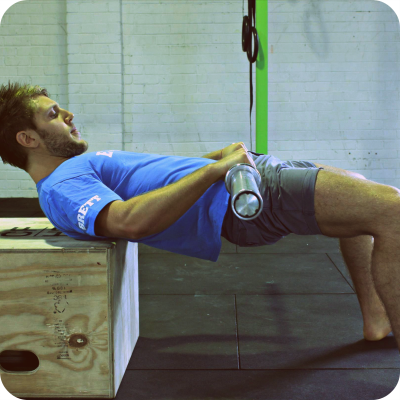
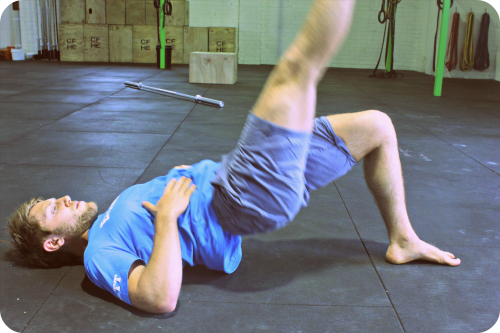
Gluteus maximus, loaded. Hip thrusts and bridges, progressed with real weight over time. Bodyweight bridges are a starting point, not a programme.
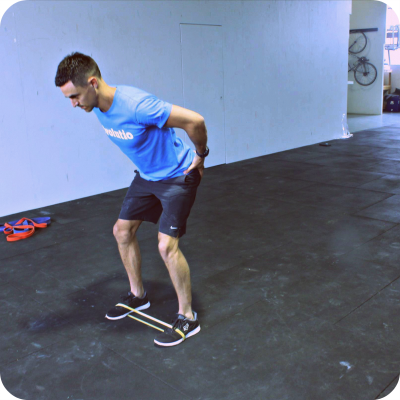
Gluteus medius, in standing. Banded walks, side steps and single-leg work. Position matters more than repetitions here: if you feel it at the front and outside of the hip, you are training the muscle you are trying to unload.
Single-leg control. Step-downs, split squats and single-leg deadlifts, watching that the knee tracks properly and the pelvis stays level. This is where the transfer to running and sport happens.
Then load it in the pattern that hurt you. Rehabilitation that stops at band walks does not prepare a hip for a heavy squat session or a long run. Progression back into your actual training is the final phase, and we base it on what your movement is doing rather than the calendar. You progress when it holds up, not when a fortnight has passed.
How long it takes
Recent, straightforward cases where load is modified and strengthening starts promptly: often two to six weeks. Longstanding pain, particularly where there has been months of compensating and other areas have started complaining: eight to twelve weeks or more.
The biggest thing that predicts a slow recovery is how long you leave it before doing anything structured. Outer hip pain you have been foam rolling for six months is a different problem from the same pain three weeks in.
When it is not the TFL
Worth ruling out, because these get mislabelled as TFL pain regularly:
Gluteal tendinopathy. Pain sits closer to the bony point on the side of your hip and is often worse lying on that side at night. It is common in women over 40 and frequently mislabelled as bursitis. The treatment is different.
Hip joint problems. Labral tears and impingement usually cause deep groin pain rather than outer hip pain, often with a catching feeling or restriction when you turn the hip inward.
Referred pain from your lower back. The lumbar spine refers into the outer hip very readily. If your symptoms change with your back position, that is worth getting assessed. We cover it on our back pain page.
Stress fracture. Uncommon, but worth considering if you are running high volume and the pain is worsening and hanging around at rest. This one needs imaging rather than a rehab programme.
If your pain is severe, waking you every night, came on after a fall, or comes with numbness or weakness, please get it looked at rather than working through this article.
Common questions
Where exactly is the TFL muscle?
At the front and outside of the hip, just below and slightly behind the bony point you can feel at the front of your pelvis. It runs down into the IT band on the outside of the thigh.
Is TFL pain the same as IT band syndrome?
No, though they are related. TFL pain is felt at your hip, where the muscle is. IT band syndrome usually shows up as pain on the outside of your knee. A tight, overworked TFL can contribute to IT band problems, which is why you often see them together.
Should I stretch or strengthen it?
Both, but strengthening your glutes is what actually resolves it. Stretching and release work will make you more comfortable in the short term, but they do not change why the muscle was overloaded.
Can I keep running or training with TFL pain?
Usually yes, with some modification. Drop your volume, avoid cambered surfaces and steep hills, and stop short of the point where the pain climbs during or afterwards. Complete rest is rarely the right answer, because it weakens the very muscles you need.
Do I need a scan?
Rarely for straightforward TFL pain. Imaging is worth considering if symptoms are not improving with appropriate treatment, if there is night pain at rest, or if a stress fracture is suspected.
Do I need a referral to see a physio in Melbourne?
No. Physiotherapy is a primary contact profession in Australia, so you can book directly. You need a GP referral only for a Medicare rebate under a Chronic Disease Management plan, or for WorkSafe, TAC and DVA claims.
If your outer hip pain has not settled with stretching and foam rolling, come and see us and we will tell you why. We are on Bromham Place in Richmond, a short walk from Richmond Station and easy to get to from Cremorne, Abbotsford, Collingwood, South Yarra and Hawthorn. Your first appointment is 45 minutes, and we send you a written plan within two days.
Alex Drew is the founder and director of Evolutio Sports Physio in Richmond, Melbourne, and has been treating patients since 2013. General information only, not a substitute for individual assessment. Related: hip physiotherapy, running injuries, CrossFit injuries, and our lower back rehabilitation guide.
Self-myofascial release with a massage ball:
Alternatively, you can use a massage or tennis ball for more targeted pressure on specific areas.
Place the ball between your hip and a firm surface (e.g., the floor or a wall).
Apply pressure to the ball and roll it over the TFL area to find trigger points.
When you locate a tender spot, hold the pressure on it for about 20-30 seconds, allowing the muscle to release.
Stretching the TFL
Stand with feet shoulder-width apart.
Cross one leg behind the other and lean slightly to the opposite side.
Keep the crossed leg straight and the foot flat on the ground.
You should feel a stretch on the outer side of the hip.
Hold the stretch for about 20-30 seconds, then switch to the other side.
Hip flexor stretch
As the hip flexors and TFL are interconnected, stretching the hip flexors can indirectly release tension in the TFL prior to exercise.
Kneel on one knee and step the other foot forward into a lunge position.
Tuck your pelvis under and gently push your hips forward.
You should feel a stretch in the front of your hip on the side of the kneeling leg.
Hold the stretch for about 20-30 seconds, then switch to the other side.

The Barbell Hip Thrust for Glut Max activation - Evolutio

Resisited Sumo/ Glut Med Walks

Single Leg Glut Bridge - Great for additional activation of a weak or pre injured side